
Filed under: Group News, Science | Tags: biodegradable plastics, catalysis, graduate research, Green polymers, lactide, lithium, Publication, undergraduate research
The journal Dalton Transactions has accepted a paper from the Kozak group describing the work of Rebecca (PhD 2012), Amy (B.Sc. 2010) and Hua (M.Sc. in progress) on lithium complexes that polymerize rac-lactide. We thank our co-authors Celine Schneider and Louise Dawe for help with valuable solid-state NMR and X-ray diffraction studies.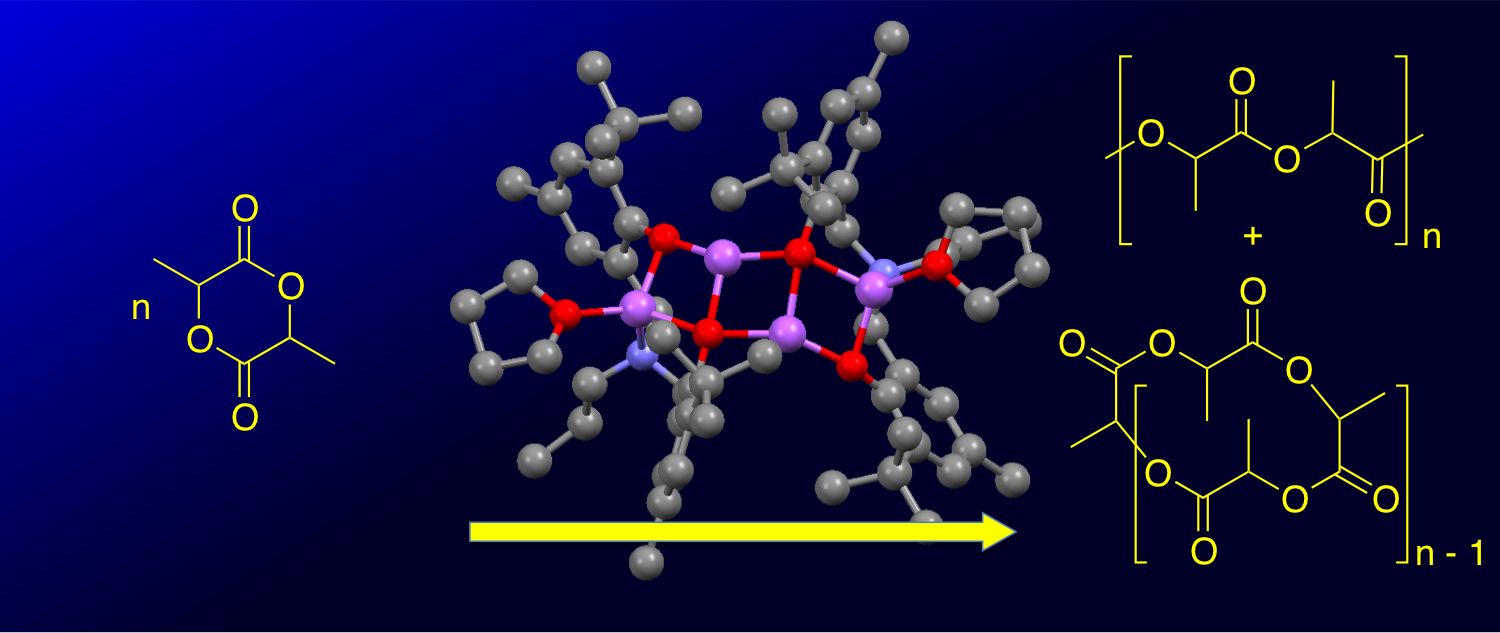
Filed under: Group News, Science | Tags: aluminum, biodegradable plastics, caprolactone, carbon dioxide, catalysis, chemistry, chromium, Coordination Chemistry, Green polymers, Publication, undergraduate research
Yesterday, the profs got good news from the publishers 😀
Dr. Kerton’s paper was accepted by Organometallics and Dr. Kozak’s paper was accepted by Dalton Transactions.
The Organometallics paper is about the synthesis and reactivity of some aluminum complexes. Some of the compounds were prepared for the first time by Marcus Drover (during his SWASP in summer 2010) and Stephanie Barbon (in summer 2011 as an NSERC USRA/ICE student). Kinetic studies were performed by Nduka on their activity in ring-opening polymerization of caprolactone. He also discovered that the chloride complex could initiate the copolymerization of carbon dioxide and cyclohexene oxide. http://dx.doi.org/10.1021/om300757u
The Dalton Transactions paper contains research results from Rebecca’s PhD thesis on copolymerization of carbon dioxide with propylene oxide and addition reactions between styrene oxide and carbon dioxide. This is the second paper published from the Kozak group Cr catalysts for this reaction (Paper 1: Inorg. Chem. 2012) and also builds on results obtained using related Co complexes (Catalysis Communications 2012).
A big thank you to Louise Dawe for her expertise in X-ray crystallography and to all the students involved!
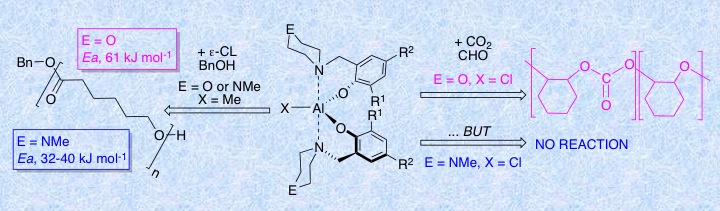
Al complexes for ring-opening polymerization of caprolactone and activation of carbon dioxide
Filed under: Group News, Science, St. John's | Tags: biodegradable plastics, green chemistry, Memorial University, polycarbonate, polylactide, research, sustainable development
Chris was interviewed on the Rogers TV St. John’s local television program “Out of the Fog” yesterday. The segment discussed the problems with currently used plastics and how biodegradable and renewably-sourced plastics, such as those being investigated in the MUN Green Chemistry Group, may be able to address some of the long term environmental issues.
 Green Chemistry @ MUN